How strengths-based development drives collaboration, engagement, resilience and performance at work
Organisations invest significant resources in developing their people, but one question continues to challenge learning and HR leaders:
How do we know whether development is creating real business impact?
While participation rates and satisfaction scores can tell us whether people enjoyed a development experience, they don’t reveal whether learning is changing workplace behaviour or contributing to organisational performance.
To address this challenge, Strengthscope analysed feedback from approximately 15,000 individuals, collected before and around three months after they completed a Strengthscope® profile. The findings provide valuable insight into how strengths-based development influences awareness, behaviour and workplace outcomes.
Key Findings
- Strengths awareness increased significantly three months after participants completed their Strengthscope® profile.
- 70% of respondents reported a positive impact on collaboration with colleagues.
- More than 60% reported improvements in engagement, resilience, wellbeing and performance.
These findings suggest that strengths-based development can help create the conditions that support higher performance, stronger teamwork and more sustainable success.
Why Measuring Learning Impact Matters
Many organisations evaluate learning initiatives using participant feedback and knowledge assessments. These approaches help measure engagement with learning and understanding of concepts, but they don’t always show whether learning has translated into meaningful workplace change.
Strengthscope’s evaluation approach aligns with the widely recognised Kirkpatrick Model of Learning Evaluation, which assesses development across four levels:
- Reaction – How participants respond to the learning experience.
- Learning – What participants learn and understand.
- Behaviour – How learning influences workplace behaviour.
- Results – The impact behavioural changes have on organisational outcomes.
While many organisations effectively measure reaction and learning, demonstrating behavioural change and business results is often more difficult.
That’s where strengths-based measurement becomes valuable.
Strengths Awareness: The Foundation of Performance
Before people can perform at their best, they need to understand what enables them to do so.
Strengths-based development goes beyond building new skills. It helps individuals develop a deeper understanding of:
- What energises them
- Where they naturally perform at their best
- How they can make their greatest contribution at work
Research has consistently linked strengths awareness to positive business outcomes. According to Rigoni and Asplund (2016), organisations that focus on employees’ strengths report:
- 10% to 19% higher sales
- 14% to 29% higher profit
- 3% to 7% higher customer engagement
- 9% to 15% higher employee engagement
- Significantly lower employee turnover in high-turnover organisations
Sustained Growth in Strengths Awareness
Strengths awareness continues to increase months after the intervention.
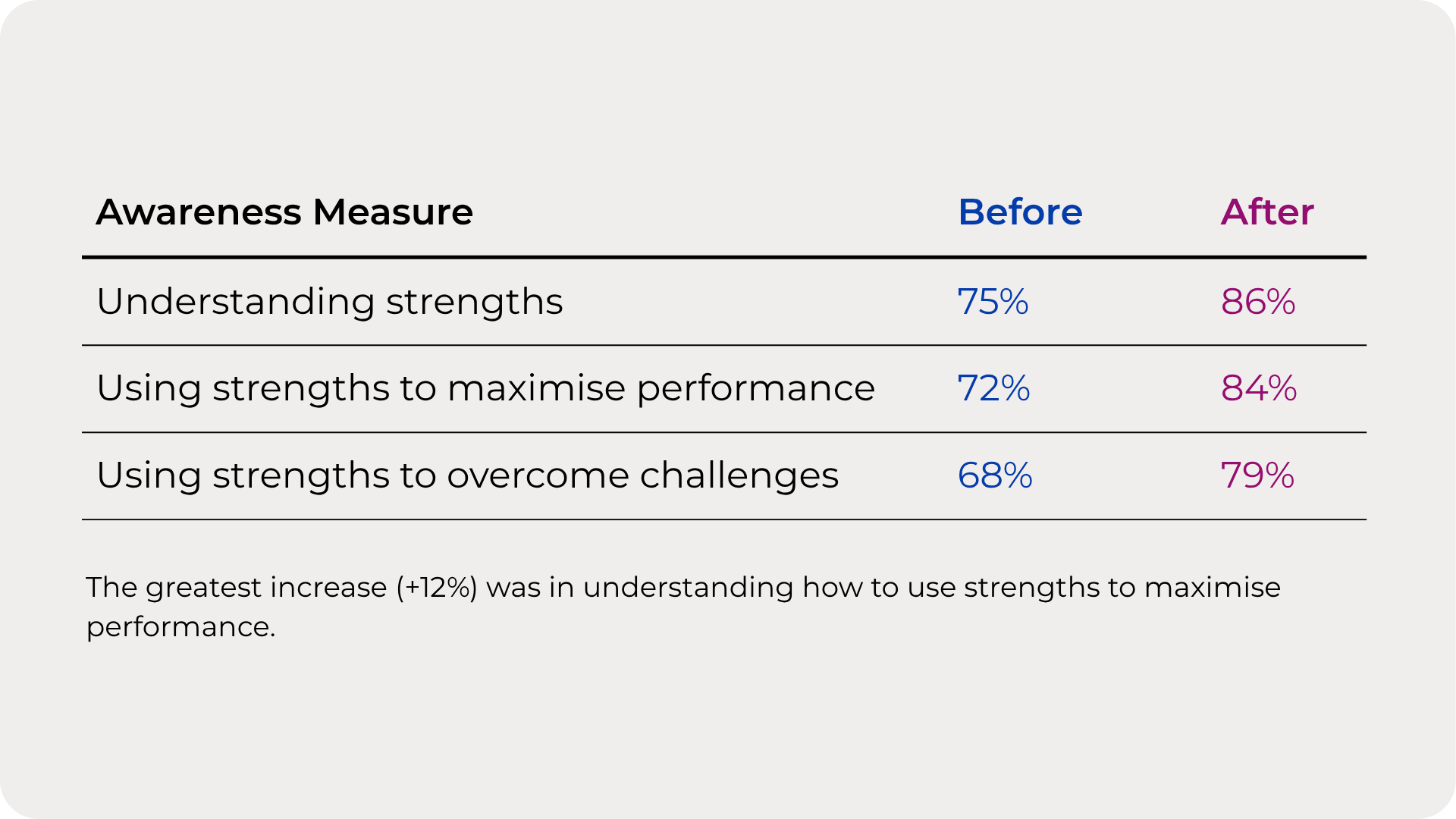
Three months after completing their Strengthscope® profile, participants reported meaningful increases in their understanding of:
- Their strengths in a work context
- How to use strengths to maximise performance
- How to use strengths to overcome challenges
The largest improvement was a 12% increase in understanding how to use strengths to maximise performance, suggesting that strengths-based development helps individuals connect personal insight with practical workplace effectiveness.
Importantly, these improvements were sustained over time rather than being limited to immediate post-programme enthusiasm.
Measuring the Impact on Business Outcomes
Learning creates value when it changes behaviour.
For this reason, Strengthscope also measures the extent to which participants perceive improvements in workplace outcomes closely linked to organisational effectiveness:
- Collaboration
- Engagement
- Resilience
- Wellbeing
- Performance
Collaboration: The Strongest Reported Impact
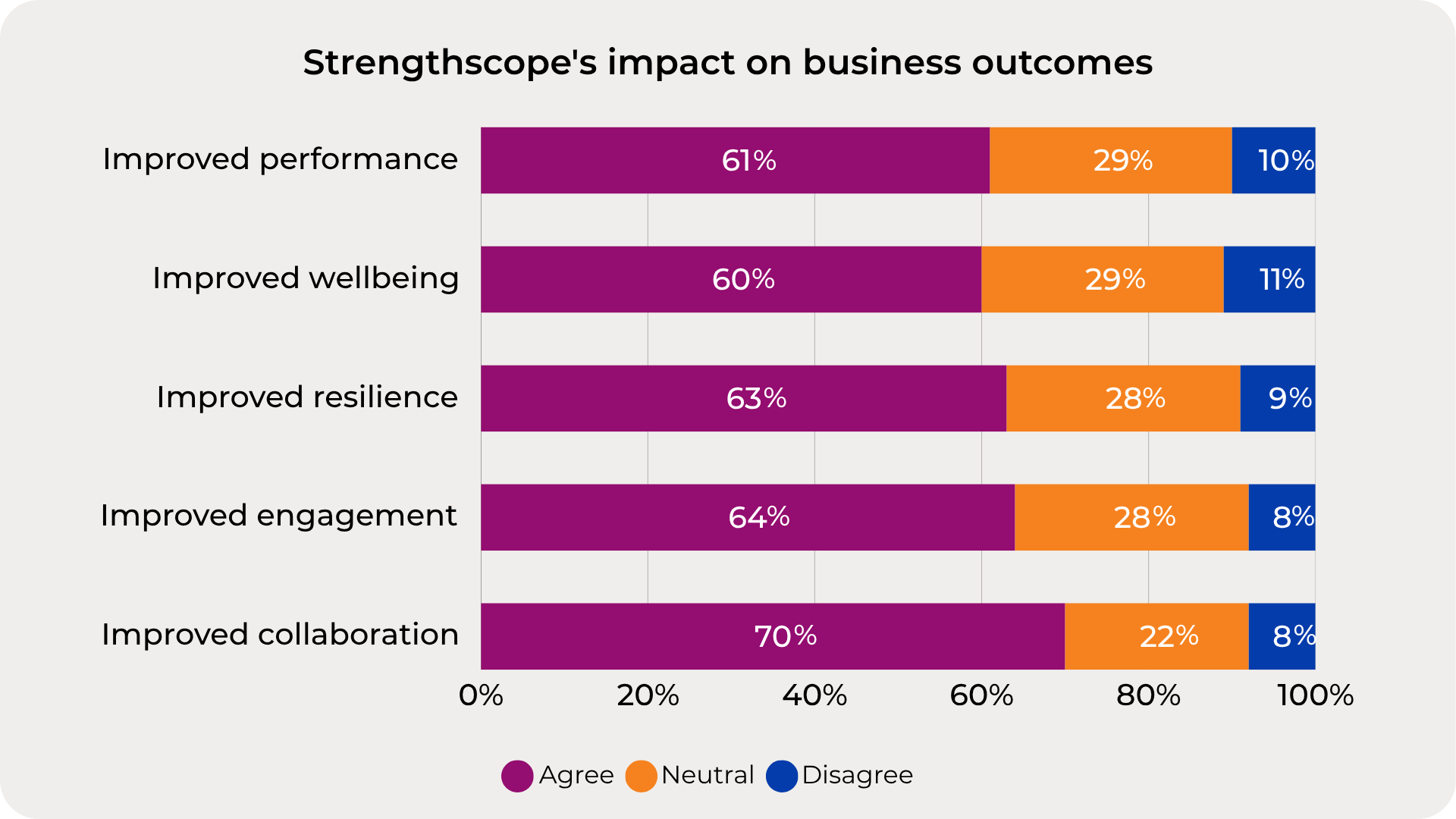
70% of respondents said Strengthscope positively impacted how they work with colleagues.
Collaboration emerged as the strongest reported area of impact.
In today’s complex and interconnected workplace, organisational success increasingly depends on how effectively people work together. Strengths-based development helps individuals understand both their own contribution and the strengths others bring to a team.
This increased awareness can lead to:
- Better communication
- Stronger partnerships
- Greater trust
- More effective problem-solving
The consistency of this finding across industries suggests that strengths-based development offers a highly transferable approach to improving collaboration.
Engagement: Creating the Conditions for Contribution
64% of respondents reported higher levels of engagement at work.
Employee engagement remains one of the strongest predictors of organisational performance, influencing retention, discretionary effort, customer experience and business outcomes.
When individuals feel recognised for what they naturally do well, they are often more motivated to contribute and invest in shared goals.
The findings suggest that strengths-based development can help create workplaces where people feel more connected to both their role and organisational purpose.
Resilience and Wellbeing: Supporting Sustainable Performance
63% reported a positive impact on their ability to deal with setbacks and challenges.
60% reported a positive impact on their overall wellbeing.
The modern workplace demands adaptability. Employees are expected to navigate uncertainty, manage competing priorities and perform under pressure.
The findings indicate that strengths-based development can play an important role in building resilience by helping people draw on their natural capabilities during challenging situations.
At the same time, the data highlights the importance of wellbeing.
Resilience helps people continue through challenges. Wellbeing helps ensure they can continue performing effectively over the long term. Organisations seeking sustainable performance may achieve the greatest impact by combining strengths development with broader wellbeing initiatives.
Performance and Results
61% of respondents said Strengthscope positively impacted their performance and results at work.
Performance remains the ultimate objective of most development initiatives.
While workplace performance is influenced by many factors, strengths-based development helps individuals understand how they can contribute most effectively and apply their strengths intentionally to achieve their goals.
The positive findings across collaboration, engagement, resilience and performance suggest that strengths awareness may play an important role in creating the conditions that enable individuals and teams to perform at their best.
What Could This Mean for Business Performance?
Research consistently links improvements in collaboration, engagement and wellbeing with measurable business outcomes.
For example:
- Poor collaboration can cost organisations significant productivity losses.
- Higher engagement is associated with increased sales growth.
- Improvements in wellbeing can positively influence productivity, retention and absence levels.
Using conservative assumptions, organisations may find that even small improvements in employee effectiveness create meaningful financial value when applied across large employee populations.
However, the most accurate assessment comes from linking strengths-based development directly to business metrics such as:
- Productivity
- Sales performance
- Customer satisfaction
- Retention
- Employee engagement
- Operational performance
A Practical Framework for Measuring Development Impact
Organisations today face increasing pressure to demonstrate the value of investment in people development.
Strengthscope’s evaluation approach helps organisations measure both learning outcomes and workplace impact, creating a clearer picture of how development contributes to organisational performance.
The findings from 15,000 respondents suggest that strengths-based development can deliver sustained improvements in strengths awareness while also supporting positive outcomes across collaboration, engagement, resilience, wellbeing and performance.
Importantly, many respondents in this research experienced only a relatively light-touch intervention, receiving a Strengthscope profile and self-guided resources. Even with this level of support, participants reported meaningful improvements in workplace outcomes.
The evidence points to a simple conclusion:
Strengths-based development does more than help people understand themselves. It helps create the conditions in which individuals, teams and organisations can perform at their best.