Organisations are restructuring, and teams are being reshaped, merged, downsized, or redirected in today’s working world. Amid this turbulence, many employees are experiencing the psychological and emotional impact of organisational transitions and change fatigue. They’re left wondering: What’s next? How do I contribute meaningfully in this shifting landscape?
One powerful answer lies in the strengths approach, a method that helps individuals and teams identify, harness, and apply their unique strengths to build resilience, cohesion, and high performance.
____________________________________________________________________
Table of contents
- Why Strengths Matter More Than Ever
- Strengths Meet Tuckman: A Developmental Power Combo
- Embedding Strengths in Team Culture
- Final Thoughts – Why (and how to) apply the strengths approach to teams
____________________________________________________________________
Why Strengths Matter More Than Ever
When everything feels uncertain, knowing your strengths can offer a sense of control and clarity. For teams, discovering collective strengths fosters a shared identity and purpose, which are key ingredients for high performance.
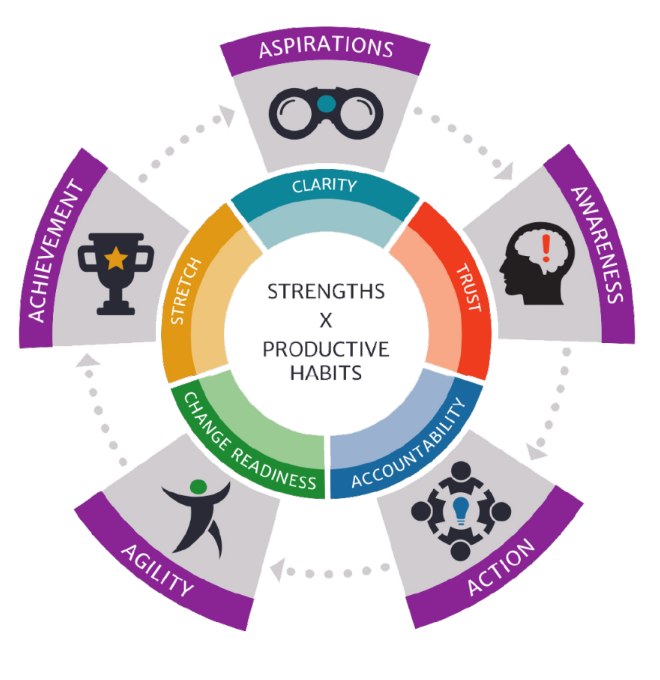
Using tools like StrengthscopeTeam™, teams can explore their individual and collective strengths, identify any potential performance risks, and take deliberate action to align work with what energises them. This process follows The Peak Performing Team Pathway™:
- Aspirations/Clarity: At the outset, teams benefit from establishing a shared vision that defines their objectives, roles, and responsibilities. There should be emphasis on setting clear expectations, direction, and behavioural norms.
- Awareness/Trust: Building trust begins with understanding each team member’s strengths and potential performance risks in a constructive and psychologically safe way.
- Action/Accountability: As the team progresses, members begin leveraging each other’s strengths to make decisions, commit to actions, and uphold accountability.
- Agility/Change Readiness: At this point, the team becomes more agile and capable of responding positively to change. And can actively lean on one another’s strengths to achieve successful outcomes in an agile way.
- Achievement/Stretch: In the final stage, high-performing teams celebrate successes and actively seek ways to enhance their effectiveness. Teams should engage in constructive feedback and recognition to drive continuous improvement.
This model helps teams move from simply knowing their strengths to actively leveraging them to improve collaboration, productivity, and morale.
Strengths Meet Tuckman: A Developmental Power Combo
Pairing the strengths approach with Tuckman’s team development model (Forming, Storming, Norming, and Performing) provides a practical roadmap to accelerate team development. Let us look at how Strengthscope® tools can support each stage.
Forming: This is the ‘honeymoon’ phase, team members are polite, enthusiastic, and eager to connect. But beneath the surface, there’s uncertainty about roles, goals, and expectations. We can use StrengthscopeTeam™ to surface individual strengths and create a shared language from day one, and facilitate a strengths showcase to help team members understand how each person contributes uniquely.
Storming: Conflict emerges as personalities clash and priorities diverge. This stage is uncomfortable but essential. Teams must work through differences to move forward. Strengthscope can help identify strengths in overdrive and areas of drain, enabling more constructive conversations. We can also use facilitated sessions to explore team habits and establish norms for open dialogue.
Norming: The team begins to gel, roles are clearer, values are shared, and collaboration improves. Constructive conflict becomes a tool for growth, not a threat. We can use StrengthscopeTeam™ to revisit strengths and potential risks and co-create a team charter that defines “how we work.”
Performing: The team is now high-functioning, interdependent, autonomous, and focused on outcomes. Decision-making is distributed, and performance is consistent. Encourage team members to play to their strengths and tap into others’ when needed. Celebrate achievements through the lens of strengths to reinforce what’s working.
Embedding Strengths in Team Culture
To make strengths stick, teams must embed them into everyday practices (performance reviews, team meetings, visual reminders, and feedback loops). Strengths-based activities and habits reinforce learning and sustain strengths in team conversations.
For example, teams might use StrengthscopeTeam™ as a reflective tool. They might review both positive and challenging experiences through the lens of strengths, asking: Which strengths helped us succeed? Which ones were missing or overused? When tackling lessons learned conversations.
Final Thoughts – Why (and how to) apply the strengths approach to teams
In a world of constant change, teams need more than just structure. They need energy, clarity, and connection. The strengths approach offers a practical and human-centred way to build those foundations. By combining tools like StrengthscopeTeam™ with proven models like Tuckman’s, teams can navigate disruption with greater agility, deepen trust, and unlock their collective potential. Whether your team is forming, storming, or performing, strengths can guide the way.
Learn more about how you can become an independent Strengthscope® practitioner here.
Looking for in-house accreditations? Explore your options here.
Schedule a discovery call with our team.